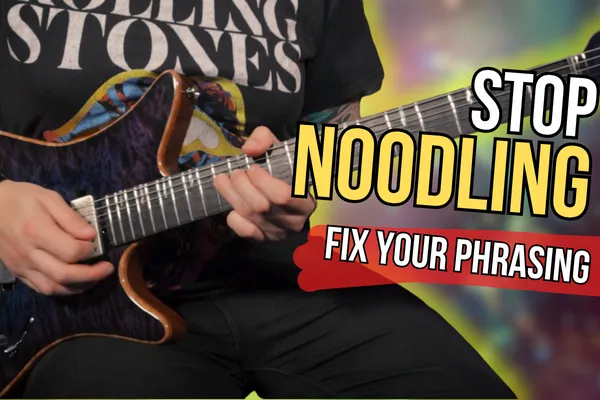
Become A Better Lead Guitarist In 7 Days With These Simple Phrasing Tricks
If your guitar solos feel repetitive, predictable, or like you're simply running scales, the problem probably isn't your technique.
It isn't because you need to learn more scales either.
In fact, one of the biggest mistakes guitar players make is believing that the answer to better solos is always more information. More scales. More modes. More licks.
The reality is much simpler.
The thing that's holding most players back is phrasing.
Phrasing is what separates a guitarist who sounds like they're practising exercises from a guitarist who sounds musical, expressive, and unique. It's not about what notes you play, it's about how you play them.
When you listen to legendary players like Eric Clapton or Jimmy Page, they're often using the same scales and notes as everyone else. What makes them sound different is their phrasing.
In this lesson, we're going to look at three simple exercises that can dramatically improve your phrasing and help you become a better lead guitarist in as little as seven days.
What Is Guitar Phrasing?
Before diving into the exercises, it's important to understand what phrasing actually means.
Many guitar players think phrasing is another technique they need to learn. It isn't.
Phrasing is simply the way you approach a series of notes.
It's how you:
Attack the strings
Use bends and vibrato
Create rhythm and space
Connect notes together
Express emotion through your playing
Think of it like speaking. Two people can say exactly the same sentence, but their tone, timing, and delivery completely change the meaning.
The same principle applies to guitar solos.
Exercise 1: Create Solos Using Only Four Notes
This is one of the most powerful phrasing exercises you can practise.
The concept is simple, choose just four notes from a scale and create an entire solo using only those notes.
For example, if you're playing in A minor pentatonic, you could use:
5th fret D string
7th fret D string
5th fret G string
7th fret G string
That's all you need for it. No additional notes allowed.
Why This Works
When most players improvise, they spend all their attention thinking about where to go next on the fretboard.
By restricting yourself to just four notes, you remove that distraction.
Instead of focusing on what to play, you're forced to focus on how to play it. Use every technique available to create variation. Use hammer-ons, pull-offs, slides, vibrato and bends.
Even though you're only using four notes, you'll quickly discover dozens of different ways to phrase them. This exercise teaches creativity, expression, and musicality far more effectively than endlessly running scales.
Exercise 2: Solo On A Single String
The second exercise is another fantastic way to break out of familiar patterns.
Instead of using multiple strings and scale boxes, lay an entire scale out on one string and create your solos there.
For example, you could map the A natural minor scale across the B string and improvise using only those notes.
Why Single-String Soloing Improves Phrasing
Most guitar players learn scales as shapes, but the problem is that we often become trapped inside those shapes.
When you move to a single string, you immediately remove all those familiar visual patterns and force yourself to think melodically. The result is often a much more vocal and expressive sound.
In many ways, single-string soloing feels similar to slide guitar or singing because you're moving horizontally across the neck rather than vertically through scale boxes.
Just because you're restricted to one string doesn't mean you're limited. You can still use all your techniques inside this framework to add different textures and expression to what you play along the string.
Combining these techniques creates incredibly expressive phrases that sound far more musical than simply moving up and down a scale pattern.
Exercise 3: Move Familiar Licks To New Positions
Most guitar players spend years developing favourite licks within the first two pentatonic positions. Eventually, this becomes a problem.
You find yourself playing the same phrases repeatedly because they're physically comfortable and familiar. Try moving those licks somewhere else.
Choose a lick you normally play in pentatonic shape one or two and force yourself to play that same phrase in shape three or four instead.
Even though the notes may be identical, everything feels different because the string choices change, the fingerings change,the tone changes and this can lead to the phrasing changing.
The result is often a completely fresh take on a lick you've played hundreds of times before.
Why This Exercise Is So Effective
When we learn scales, we tend to think very linearly. We learn a shape, we memorise a pattern and then we stay inside it.
But the same notes exist in multiple locations across the fretboard and exploring those alternative positions helps break you out of repetitive habits and reveals new phrasing opportunities you wouldn't otherwise discover.
It's one of the quickest ways to breathe new life into old ideas.
Practise These For 7 Days
If you really want to improve your phrasing, spend the next week focusing on these three exercises:
Day 1–2
Work exclusively with four-note solos.
Day 3–4
Explore single-string soloing.
Day 5–6
Move familiar licks into new pentatonic positions.
Day 7
Combine all three concepts over a backing track.
You'll be amazed at how much more musical, expressive, and confident your solos sound after just a few focused practice sessions.
The next level of lead guitar playing isn't hidden inside another scale pattern, it's already there, hidden inside your phrasing.
By limiting your note choices, exploring single-string soloing, and moving familiar licks to new positions, you'll start thinking differently about the guitar and develop a more expressive musical voice.
The best part is that none of these exercises require learning anything new, all you're doing is simply learning how to use what you already know more creatively.
And that's where great guitar phrasing begins.