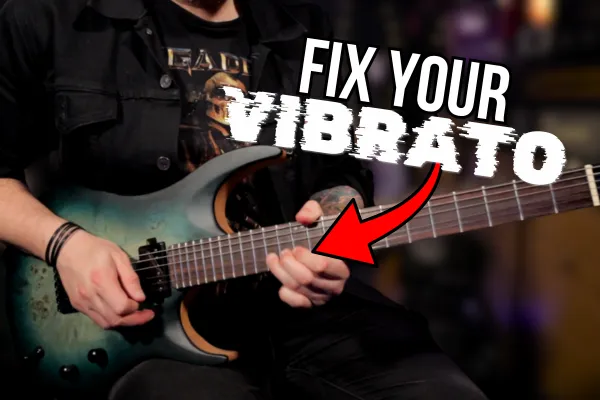
5 Ways to Improve Your Rock Vibrato (And Actually Sound Like a Rock Guitarist)
If your playing feels a bit flat, or it feels like it’s missing something there’s a good chance it’s not your scales, your speed, or even your tone.
It’s your vibrato.
That’s the part most players overlook, but it’s also the thing that makes the biggest difference. It’s what separates someone running through shapes from someone who actually sounds like a guitarist.
Listen to players like Slash or Eddie Van Halen and you’ll notice something straight away, they don’t just hit notes. They lean into them. They let them breathe, push them, shape them.
That’s vibrato.
This is a technique that adds a vocal like quality to your playing. It's what makes our playing feel and sound human, but also gives us our own unique voice.
Here are five ways to fix yours and help you get closer to sounding like your rock guitar idols.
Fix 1 - Add Width
One of the most common issues I see is vibrato that’s just too small. It’s there, but it’s barely doing anything. You can hear the intention, but it doesn’t really affect the note. If you're going to subtly or playing blues, this is fine.
But for rock...that kind of vibrato tends to sound nervous. Safe. A bit non-committal.
The fix is simple, but it feels uncomfortable at first, you need to make it bigger.
When you listen to players like Paul Gilbert or Slash, their vibrato isn’t subtle. It’s wide, obvious, and part of the sound. You can see it as much as you can hear it.
That doesn’t mean you just start yanking the string around randomly. The goal is controlled width. You’re deliberately moving the pitch further, but still returning to the same place each time.
A good way to think about it is this: if your vibrato doesn’t noticeably change the emotion of the note, it’s probably too small.
Fix 2 - Control and Speed
Once you’ve got some width in your vibrato, the next step is control, and this is where things usually fall apart.
Most players aren’t really controlling their vibrato. They’re just shaking the string and hoping for the best. The result is often uneven, a bit erratic, and not particularly musical.
There are two things to pay attention to here: how far you’re moving the string, and how fast you’re doing it.
If the distance changes every time, the pitch feels unstable. If the speed is all over the place, it loses any sense of rhythm. That’s when vibrato starts to sound messy rather than expressive.
Slowing things down helps massively. When you reduce the speed, you’re forced to hear what’s actually happening. You start to feel whether you’re hitting the same pitch each time, and whether the movement has any kind of pulse to it.
A good vibrato almost feels like it’s locked into time, even when you’re playing freely. It’s not rushed. It’s not panicked. It’s deliberate.
Fix 3 - Let the Bend Ring Before Adding Vibrato
This is a big one, especially if your bends don’t quite sound right.
A lot of players bend a note and go straight into vibrato without ever really settling on the pitch. What you end up with is something that sounds more like a wide vibrato than a clear, intentional note.
In 80s rock, the phrasing is much more deliberate. The greatest rock guitarists don't leave things to chance. There is always a lot of intent in HOW you play things.
You bend up to the note, you let it sit there for a moment, and then you add vibrato. That pause is what makes the note feel confident. It tells the listener, “this is the note I meant to hit.”
Players like Slash and Zakk Wylde do this all the time. The bend reaches the target, locks in, and then the vibrato adds emotion on top of something solid.
If the bend itself isn’t in tune, no amount of vibrato will fix it. In fact, it usually makes it more obvious.
So the priority is always: hit the note cleanly first. Then make it sing.
Fix 4 - Vibrato Technique
A lot of vibrato problems aren’t musical, they’re physical.
If you’re trying to do everything with your fingertips, you’re making life much harder than it needs to be. Finger-only vibrato tends to be small, inconsistent, and difficult to control, especially when you try to widen it.
What works far better is using your whole hand.
By anchoring your hand against the neck, even lightly, and letting your wrist and arm do the work, the motion becomes much more stable. It’s less about wiggling your fingers and more about rotating your hand in a controlled way.
It should feel solid. Supported. Like you’re in control of the string, not reacting to it.
Once that movement clicks, everything else becomes easier. You can adjust width, control speed, and stay consistent without fighting the instrument.
Fix 5 - Let Notes Breathe
This is the part that ties everything together. You can have great vibrato technically, but if you don’t give it space, it won’t matter.
A lot of players rush through phrases without ever really landing on a note. It becomes a constant stream of sound, and nothing stands out. There’s no moment for the listener to latch onto.
In 80s rock, the phrasing is much more vocal. Notes are held. They’re given time. The vibrato isn’t rushed, it develops.
That’s what gives it emotion.
Think about how a singer delivers a line. They don’t fire off notes one after another without space. They hold certain notes, shape them, and let them carry weight.
That’s exactly how your guitar playing should feel.
Sometimes the most powerful thing you can do is just stay on a note a little longer than feels comfortable, and let the vibrato do the work.
Putting This Into Practice
Vibrato is one of those things that seems small, but it changes everything. Now that you know how to fix it, start integrating small segments of vibrato focus into your routine and reap the rewards of vibrato worthy of rock guitar hero status.
When you get it right, your playing instantly sounds more confident, more expressive, and far more “finished”. It stops feeling like practice, and starts sounding like music.
And the best part is, you don’t need to learn anything new.